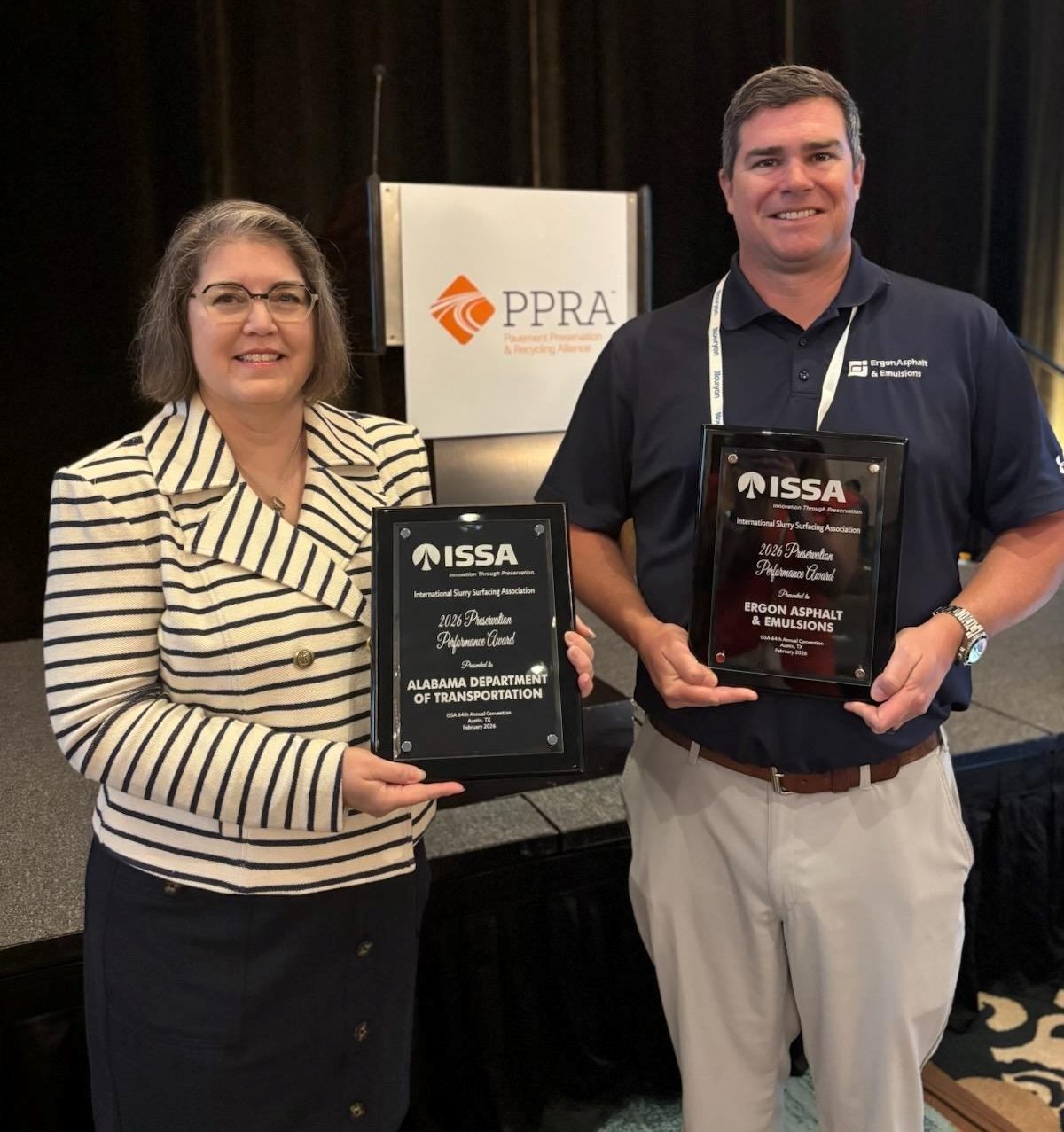
The Alabama Department of Transportation (ALDOT) earned national recognition from the International Slurry Surfacing Association (ISSA) for a pavement preservation approach that has helped keep I-20/59 safer and smoother.
ALDOT received the ISSA Preservation Performance Award, which recognizes pavement preservation projects that demonstrate long-term performance and measurable life extension over a five-plus-year period, at a ceremony in late February.
The award highlights a three-mile test section on I-20/59 completed in 2017 between mile markers 19 and 21 in Sumter County. ALDOT piloted highly modified micro surfacing as a durable, cost-effective alternative to replacing an Open Graded Friction Course (OGFC).
Lyndi Blackburn, Assistant Region Engineer for ALDOT’s West Central Region, said receiving the national award is meaningful because it validates years of careful planning and field performance.
“We are honored to be recognized by ISSA for this project,” Blackburn said. “Our goal was to find a treatment that would perform well over time and make the most of our resources. It is nice to see that work recognized at the national level.”
OGFC is commonly used on high-volume roadways because it improves surface friction and helps water drain through the pavement rather than pooling on the surface. Over time, however, OGFC can oxidize and begin to ravel, and replacing it can be expensive.
In August 2017, following micro milling of the existing OGFC surface, ALDOT and Whitaker Contracting applied the highly modified micro surfacing in two layers. Traffic returned to each treated section within only an hour after application.
The results have been strong. The 2017 demo section is still holding up well, and ALDOT expects to gain about 10 additional years of service life from the treatment.
“Where we are anticipating the advantage is the performance longevity of the micro surfacing over the OGFC,” Blackburn said. “So far, it appears to be performing as anticipated and we are happy with the results. When treatments last longer, it means fewer repairs and more opportunities to improve additional miles of roadway with available funding.”